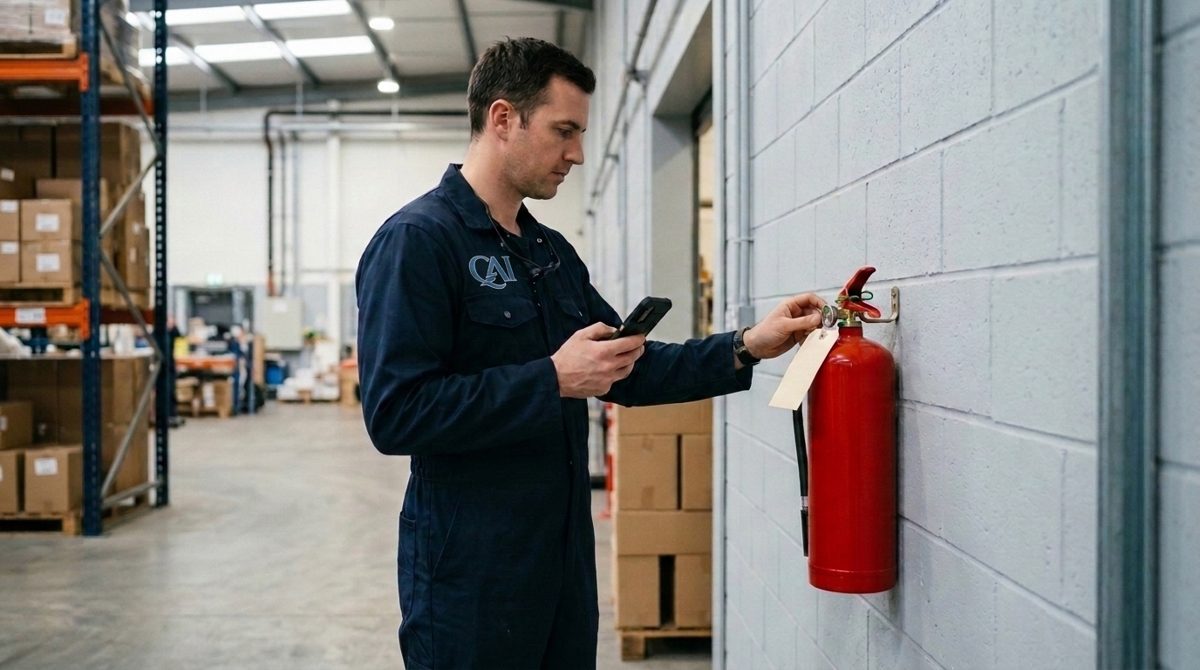

Two Standards, Two Different Jobs
Most fire compliance headaches in South Africa start with treating “fire extinguisher inspection” as one task. Under the Occupational Health and Safety (OHS) Act, it is actually two separate jobs, governed by two different SANS standards, and done by two different people.
SANS 10105-1 covers everyday site control — choosing the right extinguishers, mounting them properly, and walking the floor once a month to confirm every unit is still there, reachable, and ready to use. In practice your own team does this: the employer appoints a responsible person (usually a fire warden, health and safety representative, or facility manager) to carry out the visual check. Anything beyond looking — opening, recharging, or testing a unit — is work for an authorised technician.
SANS 1475-1 covers technical servicing and reconditioning of portable and wheeled extinguishers, while SANS 1475-2 covers fire hose reels and above-ground hydrants. That work happens every 12 months (and immediately after any discharge). For extinguishers, the Pressure Equipment Regulations add that only an authorised person employed by a permit holder may service, recharge, or test them — in practice an SAQCC Fire-registered technician working for a SANS 1475 permit holder certified by an approved body such as SABS or BSI. An internal maintenance technician cannot legally service extinguishers or issue a Certificate of Compliance.
A site needs both records in its OHS file. The annual certificate proves the equipment was mechanically sound when the contractor left; the monthly register proves someone checked that it stayed that way for the other eleven months.
| Aspect | Monthly Visual Check (SANS 10105-1) | Annual Service (SANS 1475-1 & 1475-2) |
|---|---|---|
| How often | Every month | Every 12 months, or immediately after any use |
| Who does it | Appointed internal person (fire warden, SHE rep, FM) | SAQCC Fire-registered technician at a SANS 1475 permit holder |
| What gets checked | Presence, access, signage, gauge, pin and seal, visible damage, service date | Full service, CO₂ mass check, valve/hose/nozzle, flow test on hose reels, recharge or pressure test if due |
| Record produced | Signed monthly entry in the site’s Fire Equipment Register | Service label on each unit, signed asset-by-asset service report, updated register, and CoC |
| If it is missing | Points to a lapse in routine duty of care during an audit or investigation | Statutory non-compliance; gives insurers grounds to repudiate a fire claim |
Service and Pressure Testing Intervals (At a Glance)
Annual servicing is the date everyone remembers because the sticker on the cylinder reminds them. The date that catches sites — and new contractors taking over a site — off guard is the hydrostatic pressure test. Servicing an extinguisher every year does not reset its pressure test clock.
| Equipment | Visual Check | Annual Service | Extended Test / Flow Check | Practical Note |
|---|---|---|---|---|
| DCP (Dry Chemical Powder) | Monthly | Every 12 months | Every 5 years | Overhaul and recharge alongside the 5-year test |
| Water & Foam (AFFF) | Monthly | Every 12 months | Every 5 years | Internal cylinder lining checked for corrosion |
| CO₂ (Carbon Dioxide) | Monthly | Every 12 months | Every 10 years | High-pressure cylinder; tested at a SANAS-accredited SANS 1825 station |
| Fire Hose Reels (SANS 1475-2) | Monthly | Every 12 months | Annual flow & pressure check | Unwind full hose to inspect for perishing, kinks, and gland leaks |
| Fire Hydrants (SANS 1475-2) | Monthly | Every 12 months | Annual flow & pressure check | Check valve wheel, lug washer, outlet cap, and brigade access |
| Any Discharged Unit | Immediately | Immediate recharge | If due or damaged | Even a two-second squeeze breaks the seal and drops pressure — pull it off the wall |
The 5-year pressure test ambush
A warehouse pays for annual servicing like clockwork for six years. The contractor changes, and on the first visit the new technician checks the stamp on the neck of the cylinders and discovers twenty-eight 9 kg DCPs are overdue for their 5-year pressure test. They have to come off the wall immediately, loan units have to be brought in, and an unbudgeted bill lands on the operations manager’s desk that afternoon.
Tracking Next Pressure Test Due as its own date on every asset — separate from Next Annual Service — lets you budget for batches a year ahead instead of scrambling on audit week.
The Monthly Visual Inspection Checklist (SANS 10105-1)
Walk every zone with the register once a month. You are not opening valves or testing powder — you are verifying nine straightforward things on every extinguisher, taking about thirty seconds per unit.
In its place and properly mounted
The unit is on its bracket or stand at the exact location listed on the register, and its asset number matches.
Clear to reach
No pallets, stock cages, cleaning trolleys, or locked storeroom doors standing between a person and the handle.
SANS 1186 signage visible
The photoluminescent symbolic fire sign is mounted cleanly above the unit — not faded, painted over, or hidden behind racking.
Safety pin and tamper seal intact
The pull-pin is seated and the plastic or lead tamper seal has not been snapped or twisted off.
Pressure gauge in the green
On stored-pressure DCP, water, and foam units, the needle sits squarely in the green operating band — not dropped into red, and not over-pressurised. (CO₂ units have no gauge; check the seal and horn instead.)
Cylinder body clean and undamaged
No dents, gouges, rust around the base rim, chemical staining, or signs of heat exposure.
Hose, nozzle, and horn intact
The discharge hose is supple rather than cracked or perished, the nozzle is clear of dust or wasp nests, and a CO₂ horn is tight and uncracked.
Operating label legible
Front instructions face outward and can still be read without wiping off grease or paint.
Annual service label in date
The SANS 1475 sticker is legible, carries an SAQCC Fire registration number, and the next annual due date has not passed.
While you are walking the floor: hose reels and hydrants (SANS 1475-2)
- Cabinet or reel area is unobstructed and the SANS 1186 sign is visible.
- Stopcock valve is shut, seal intact, and there is no drip from the gland or nozzle.
- Hose sits neatly on the drum with no visible cracking or perishing, and the nozzle is still attached.
- Hydrant outlet cap is in place, valve wheel is undamaged, and nothing blocks fire brigade access.
If a unit fails any check — a broken seal, a gauge creeping toward red, a missing horn — do not leave a note to “sort it out at the annual service.” Log the defect, pull or quarantine an unusable unit, and call your service provider to replace or recharge it.
What Happens During a Proper Annual SANS 1475 Service
Whether you are the facility manager signing off the job card or the fire contractor doing the work, it helps to know the difference between a compliant SANS 1475 service and a “sticker-slap.”
Match every cylinder to the register
Confirm asset ID, serial number, manufacture date, and the last hydrostatic pressure test stamp against the site register.
Weigh every CO₂ cylinder
Because CO₂ extinguishers have no pressure gauge, mass against the stamped tare weight is the only way to know whether the unit has leaked charge.
Inspect valves, seals, and agents on DCP, water, and foam units
Check gauge accuracy, powder condition (no caking or moisture), O-rings, siphon tubes, hoses, and nozzles, and fit new tamper seals.
Unwind and flow-test hose reels and check hydrants (SANS 1475-2)
Test the full length of the hose under pressure, check stopcock operation, and inspect hydrant valves and lug washers.
Quarantine condemned or pressure-test-due units
Remove rusted, dented, or 5-/10-year-due cylinders to an approved workshop and supply loan or replacement units so the building does not drop below statutory cover.
Label every unit and hand over the full paper trail
Apply a compliant service sticker showing the company’s SANS 1475 permit number, the technician’s SAQCC Fire number, and the next due date — backed by a signed asset-by-asset service report and Certificate of Compliance.
Three signs you just paid a sticker-slapper
- The technician cannot produce a current SAQCC Fire registration card when asked at reception.
- Forty-five extinguishers across a warehouse were “serviced” in twenty minutes, and no weighing scale ever left the bakkie for the CO₂ units.
- You receive a one-line invoice saying “Annual fire service” with no asset list, no defect sheet, and no Certificate of Compliance.
What Belongs in Your Fire Equipment Register (Free Template)
A Certificate of Compliance stapled into an OHS file is only half the picture if nobody can tell which forty extinguishers it actually covers. Inspectors and loss adjusters want to see an asset-level register that ties every cylinder on the wall to its monthly checks, its annual service, and its next pressure test.
Free SANS 1475 Fire Equipment Register & Monthly Log
A clean 3-tab Excel workbook (with five realistic example rows and twenty blank rows ready to fill in) plus a plain CSV copy. Download directly — no email wall.
Already running inspections from a spreadsheet or PDF? You can attach this workbook — or any existing client form — in QAI’s AI checklist builder and turn it into a mobile checklist with QR scanning in about a minute.
The Audit and Insurance Reality
Nobody fails a fire audit because they did not buy extinguishers. Sites fail — and insurance claims get contested — because of three predictable gaps in the paperwork.
The lapsed annual service. Many South African commercial fire policies include risk-maintenance warranties requiring compliance with the OHS Act and SANS standards. If a fire breaks out six weeks after your SANS 1475 service expired, or the last service was done by an unregistered provider, you have handed the insurer grounds to repudiate or reduce the claim.
The “same-pen” monthly register. Every experienced DoEL inspector and loss adjuster recognises a clipboard that had twelve months of ticks filled in with the same blue pen on the morning of the audit. Worse is signing “OK” in April, May, and June for an extinguisher that is visibly corroded or has been missing since March.
Logged defects that were never closed. Writing “CO₂ horn cracked — Basement 2” in the monthly register three months in a row, with no quote, job card, or replacement date next to it, proves the hazard was known and left unresolved. A defect log only protects you when it shows the fix.
Three questions worth checking on your site today
- Could you pull up your current SANS 1475 Certificate of Compliance and matching asset register in under two minutes?
- Do you know which extinguishers on your site hit their 5-year or 10-year pressure test in the next twelve months?
- If a monthly check failed last month, is there a dated record showing the unit was repaired or replaced?
This article is practical operational guidance, not legal advice. Always confirm specific obligations against the current editions of SANS 10105-1, SANS 1475-1, and SANS 1475-2, your local municipal fire by-laws, and your commercial insurance policy wording.
Finish the fire report before you leave site
QR-tagged extinguishers, offline checklists in basements and plant rooms, and same-day signed PDF reports.
Where Paper Registers and Spreadsheets Break Down
It is worth being honest about when you do not need software. If you manage a single office with six extinguishers and one service visit a year, the Excel register above printed into your OHS file — plus a recurring calendar reminder a month before renewal — is genuinely enough.
Paper and spreadsheets break down when the numbers grow: multi-site commercial properties, large warehouses, and especially fire protection contractors servicing dozens of client sites a month. Four failure points show up every time:
Signal dies right where the equipment sits
Basement parkades, pump rooms, plant rooms, and concrete stairwells are where extinguishers, hose reels, and hydrants live — and where mobile signal disappears. Cloud-only apps stall, so technicians go back to clipboards and retype the site report from memory at the end of the day.
What it looks like: A technician finishes 60 units in a Sandton basement, loses two photos, and spends Friday evening typing serial numbers from handwritten notes into a Word template.
Failed checks never become quoted work
A technician spots three perished hose reels, two missing SANS 1186 signs, and four 9 kg DCPs due for 5-year testing. They note it on a carbon job card in the bakkie. By the time the office reads it four days later — if it does not get lost first — the moment has passed and nobody follows up.
What it looks like: The site stays half-compliant, and the contractor leaves thousands of rands of legitimate remedial work unquoted every month.
5-year tests and annual renewals slip through spreadsheets
When each client sits in its own folder of PDFs and Excel sheets, renewals depend on someone remembering to check a tab in time. Miss the reminder by three weeks and either the client fails an audit or another contractor walks in first.
What it looks like: A client phones in a panic because their insurer just asked for an updated CoC — and nobody realised their renewal passed last month.
Clients wait days for the report they need today
Facility managers want a clean, signed PDF report and updated asset list the day the technician leaves site, not next Thursday after someone in admin has formatted photos into a spreadsheet.
What it looks like: The annual visit finished on Tuesday morning, but the client is still chasing the signed register on Friday afternoon ahead of a Monday audit.
How QAI handles the whole visit — from first scan to invoice
QAI was built for the exact workflow where paper registers fall apart, whether you are running monthly site checks across multiple buildings or servicing client sites as a fire protection contractor.
Explore Offline Mode, Quotes & Invoicing, and QAI for South African teams.
Frequently Asked Questions
How often must fire extinguishers be inspected and serviced in South Africa?
Two intervals apply. Under SANS 10105-1, an appointed person on site must carry out a visual check every month and record it in the Fire Equipment Register. Under SANS 1475-1, an SAQCC Fire-registered technician employed by a SANS 1475 permit holder must service every extinguisher at least once every 12 months, and immediately after any discharge.
Can our own maintenance team do the annual SANS 1475 service?
No. Your internal team can — and should — handle the monthly visual checks under SANS 10105-1. The annual technical service, recharging, pressure testing, and issuing of a Certificate of Compliance under SANS 1475 may only be done by an SAQCC Fire-registered technician employed by a SANS 1475 permit holder.
How often do fire extinguishers need pressure testing under SANS 1475?
Stored-pressure dry chemical powder (DCP), water, and foam extinguishers require hydrostatic pressure testing every 5 years, alongside an overhaul. Carbon dioxide (CO₂) extinguishers are high-pressure cylinders and require hydrostatic testing every 10 years at a SANAS-accredited SANS 1825 test station.
What is the difference between SANS 10105-1, SANS 1475-1, and SANS 1475-2?
SANS 10105-1 covers the user’s responsibilities — selection, placement, signage, and monthly visual checks. SANS 1475-1 covers annual servicing and reconditioning of portable and wheeled fire extinguishers. SANS 1475-2 covers annual servicing of fire hose reels and above-ground fire hydrants.
Can an insurer repudiate a fire claim if our SANS 1475 service is overdue?
Yes, it is a real risk. Commercial fire insurance policies in South Africa commonly contain risk-maintenance clauses requiring compliance with the OHS Act and SANS standards. An expired annual service, an unaccredited contractor, or missing monthly inspection records can give an insurer grounds to contest or reject a claim.
How do I check if a fire servicing technician is actually SAQCC Fire registered?
Ask to see their SAQCC Fire registration card before work starts — it shows their name, photo, registration number, scope of work, and expiry date. You can also check their registration with SAQCC Fire, and confirm the company holds a valid SANS 1475 permit from an approved certification body such as SABS or BSI.
Does QAI work offline in basements and plant rooms?
Yes. Switch the QAI mobile app to Offline Mode on iPhone or Android and your team can scan QR tags, run SANS 1475 checklists, take defect photos, and capture client signatures with no signal at all. Everything uploads automatically once back in coverage.